
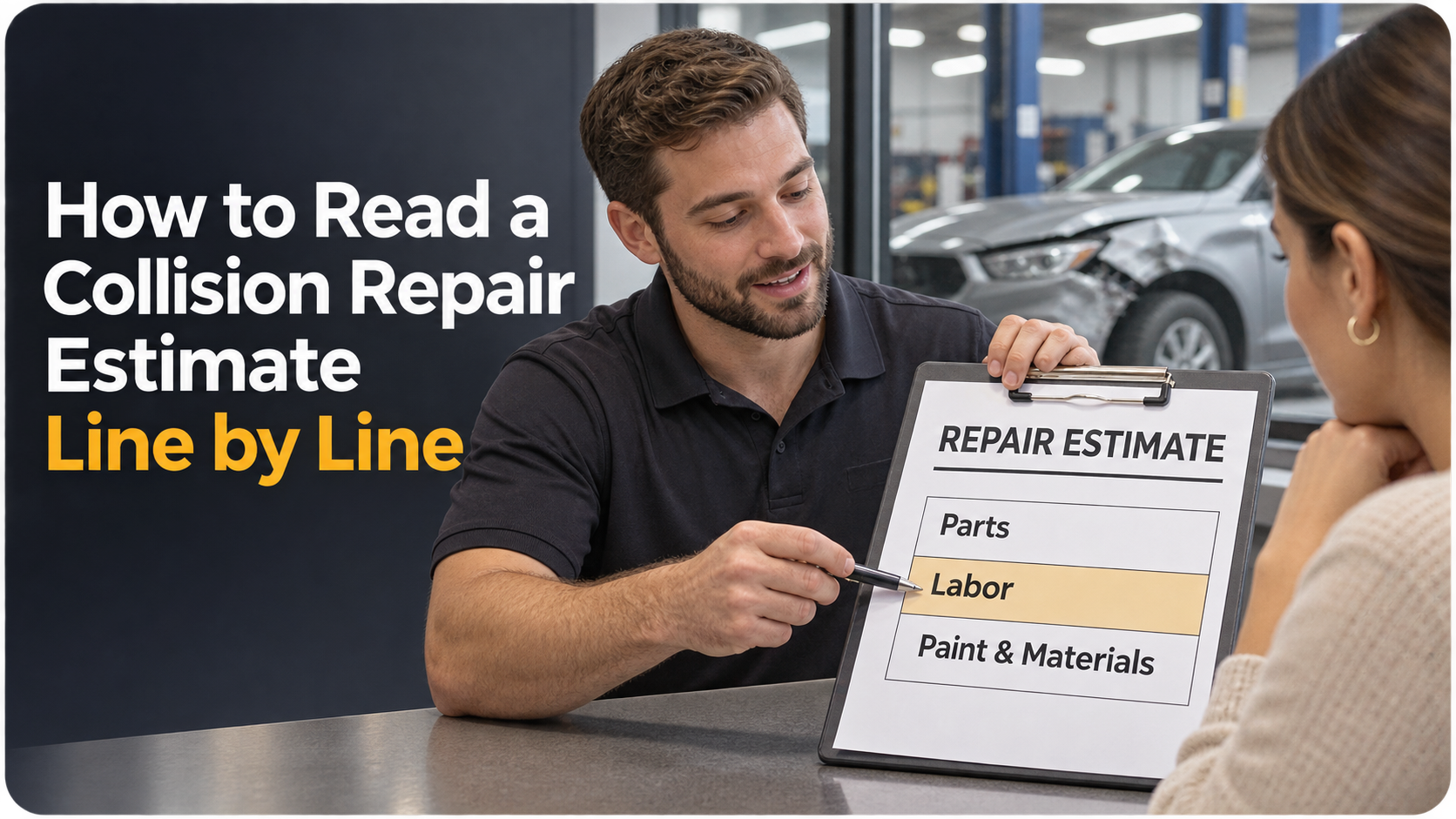
How to Read a Collision Repair Estimate: A Line-by-Line Guide
A collision repair estimate lists every repair your vehicle needs, the parts that will be used, the labor hours for each job, and the paint and materials required, then totals it all up with tax and your deductible. Most estimates follow the same layout no matter which shop or insurance company wrote them, so once you know how to read one line, you can read the whole thing.
At Arizona Collision Center in Tempe, we walk customers through their estimates every day. Here’s the same walk-through, line by line, so you know exactly what you’re paying for and what questions to ask. (If you were just in an accident and haven’t gotten an estimate yet, start with our guide on what to do after a car accident in Tempe.)
Start With The Header
The top of the estimate identifies the job. Before you look at a single repair line, check that these details are right:
- Your name and contact information
- Vehicle information: year, make, model, trim, color, mileage, and the VIN (vehicle identification number). The trim and options matter, because a part for a base model can be different from the part for a higher trim.
- Insurance details: your insurance company, claim number, and the adjuster’s name, if this is an insurance repair
- Point of impact: where the vehicle was hit, often shown as a diagram or code
- Estimate date and estimate software: most estimates are written in one of a few industry estimating systems, which is why they look so similar
If the VIN or trim is wrong, the parts and prices on the rest of the estimate may be wrong too.
How Each Repair Line is Laid Out
The body of the estimate is a list of repair lines, usually grouped by area of the vehicle (front bumper, hood, left fender, and so on). Each line typically includes:
- Line number
- Operation: what’s being done to the part (see the codes below)
- Description: the part or task, such as “Front bumper cover” or “Headlamp assembly LT”
- Part number and part type: which tells you whether the part is new from the manufacturer, aftermarket, or used
- Quantity and price: the cost of the part
- Labor hours: how long the job is expected to take
- Paint hours: time to prepare and paint the part, listed separately from repair labor
Here’s an example of what a single line might look like:
| Line | Operation | Description | Part type | Price | Labor | Paint |
| 12 | Repl | Front bumper cover | OEM | $485.00 | 1.5 | 2.8 |
Read that as: replace the front bumper cover with a new manufacturer part, 1.5 hours to install it, and 2.8 hours to paint it.
Common Operation Codes
| Code | Meaning | What it means for your car |
| Repl | Replace | The damaged part is removed and a new or replacement part is installed |
| Rpr | Repair | The existing part is fixed, for example by pulling out a dent, instead of being replaced |
| R&I | Remove and install | A part is taken off to reach the damage, then put back on (like removing a headlight to fix the fender behind it) |
| R&R | Remove and replace | Similar to Repl; the part comes off and a replacement goes on |
| Refn | Refinish | The part is painted |
| Blnd | Blend | Paint is feathered into the panel next to the repair so the color matches |
| O/H | Overhaul | An assembly is taken apart and rebuilt |
| Subl | Sublet | Work sent to a specialist outside the shop, such as an alignment or glass replacement |
Why “blend” matters. Factory paint can vary slightly from car to car, and Arizona sun fades paint over time. If a shop paints a new door to match the paint code exactly and stops at the door’s edge, you may see a visible difference next to the original fender. Blending paint into the neighboring panels hides that line. Seeing blend on an estimate is a sign the shop is planning for a color match you can’t spot. Learn more about how we approach auto body painting and color matching.

Labor: Hours and Rates
Labor is usually the biggest part of the bill. Estimates list labor in hours, then multiply by the shop’s hourly rate for each type of work:
- Body labor: removing, installing, and repairing panels
- Refinish labor: prepping and painting
- Frame or structural labor: measuring and straightening the vehicle’s structure
- Mechanical labor: suspension, cooling system, and other mechanical parts damaged in the crash
- Diagnostic or electrical labor: scanning and repairing electronic systems
The hours come from industry labor guides that estimate how long each operation takes on your specific vehicle. Rates vary by shop and by type of labor, which is one reason two estimates for the same damage can come out different.
Parts: OEM, Aftermarket, Used, and Reconditioned
The part type is one of the most important things to check, because it affects fit, finish, safety, and warranty. You’ll usually see one of these:
- OEM (original equipment manufacturer): a new part made by or for your vehicle’s manufacturer, the same as what came on your car
- Aftermarket (often “A/M”): a new part made by a different company to fit your vehicle
- Used, recycled, or LKQ (“like kind and quality”): a part taken from another vehicle
- Reconditioned or re-manufactured: a used part that has been repaired or rebuilt, common for items like wheels and bumpers
Arizona requires a written notice for aftermarket crash parts. Under Arizona law (A.R.S. § 44-1293), a repair shop can’t use a non-OEM aftermarket crash part unless you’re advised in a written notice attached to or printed on the estimate. That notice explains that the estimate uses parts from a source other than your vehicle’s manufacturer, and that warranties for those parts come from their maker, not your car’s manufacturer. If you see that notice on your estimate, ask which parts it applies to.
Your insurance policy may say which part types it will pay for. If you want OEM parts and your policy doesn’t cover them, ask the shop what the difference in price would be. For more detail, see can an insurance company refuse to pay for OEM collision parts?
Paint and Materials
You’ll usually see a line for paint and materials, sometimes listed as “paint supplies” or “refinish materials.” This covers paint, primer, clear coat, sandpaper, masking, and other supplies used during the job. It’s typically calculated from the number of paint hours on the estimate, so more panels painted means a higher materials charge.

Scans and Safety System Calibrations
Modern vehicles are full of sensors and cameras for features like lane-keeping assist, automatic emergency braking, adaptive cruise control, and blind-spot monitoring. These are known as ADAS (advanced driver assistance systems). After a collision, you may see:
- Pre-repair scan: a computer scan that finds hidden electronic damage and stored fault codes before work starts
- Post-repair scan: a scan after repairs to confirm every system is working and no warning codes remain
- Calibration: re-aiming cameras and radar sensors so safety features work correctly
Even a minor bumper or windshield repair can knock a sensor out of alignment. These lines are there for your safety, so they’re worth keeping on the estimate.
Sublet and other charges
Sublet lines cover work the shop sends to a specialist, such as wheel alignment, glass replacement, or certain calibrations. Other charges you might see include hazardous waste disposal, towing, storage, and a rental car if your coverage includes one.
The totals section
At the bottom, the estimate adds everything up. Here’s what each line means:
- Parts total: all parts on the estimate
- Labor totals: hours for each labor type multiplied by its rate
- Paint and materials
- Sublet and miscellaneous charges
- Tax
- Gross total: the full cost of the repair
- Deductible: the amount you pay under your policy
- Betterment or depreciation: a deduction some insurers take when a worn part, like a tire or battery, is replaced with a new one that leaves your car in better condition than before the accident
- Net total or insurance payment: what the insurance company pays after your deductible and any betterment
If you’re unsure why a betterment charge appears, ask the shop or your adjuster to explain it. You can question it.
Why the Estimate Can Change: Supplements
An estimate is written from what’s visible before the car is taken apart. Once the shop removes the bumper or a door panel, it often finds damage that couldn’t be seen at first, like a cracked bracket, a bent reinforcement bar, or a damaged sensor. When that happens, the shop writes a supplement, which is an addition to the original estimate, and sends it to the insurance company for approval.
Supplements are normal and very common. They don’t mean the shop is padding the bill. They mean the first estimate was based on what could be seen from the outside. Here’s more on the hidden damage you can’t see after a car accident and why it matters.
Questions to ask about your estimate
Before you approve repairs, it’s worth asking:
- Which parts are OEM, and which are aftermarket or used?
- Is blending included where new paint meets original paint?
- Are pre- and post-repair scans and any needed calibrations included?
- Does the shop follow your vehicle manufacturer’s repair procedures?
- What warranty comes with the repairs?
- How will the shop handle supplements if more damage turns up?
A good shop will answer all of these without hesitation. Once repairs are done, a post-repair inspection confirms the work matches what was on the estimate.
Comparing estimates from different shops or your insurer
It’s common for an insurance company’s estimate to come in lower than a repair shop’s. The insurer’s appraiser often writes the estimate from photos or a quick inspection, while the shop that will actually do the work plans for everything the repair requires, including scans, blending, and manufacturer procedures. When comparing estimates, look at the part types, the operations listed, and whether safety steps are included, not only the total.

You have the right to choose your repair shop in Arizona
Under Arizona law (A.R.S. § 20-468), you have the right to choose any repair facility to fix your vehicle after a collision, subject to your insurance company’s right to be notified of the claim under your policy. Your insurer may recommend a shop, but you don’t have to use it. Our insurance claims assistance team can help you work through the process with your insurer.
Frequently Asked Questions
Is the insurance company’s estimate the final price? No. It’s a starting point. If the shop finds more damage after taking the vehicle apart, it submits a supplement to the insurance company for the additional repairs.
Why are two estimates for the same damage so different? Shops can differ in labor rates, the part types they use, whether they include blending and safety scans, and how closely they follow manufacturer repair procedures. Compare those details line by line, not just the total.
What does R&I mean on a car repair estimate? R&I means remove and install. A part is taken off to reach the damage behind it and then reinstalled, such as removing a headlight to repair the fender underneath.
What’s the difference between OEM and aftermarket parts? OEM parts are made by or for your vehicle’s manufacturer. Aftermarket parts are made by other companies to fit your vehicle. In Arizona, a shop must give you written notice on the estimate before using aftermarket crash parts.
Do I have to use the shop my insurance company recommends? No. Arizona law gives you the right to choose your own repair facility.
Get a clear, honest estimate in Tempe
Arizona Collision Center is an I-CAR Gold Class collision repair shop in Tempe, serving drivers across Tempe, Chandler, Gilbert, Mesa, Phoenix, and Scottsdale. We’ll write a detailed estimate, walk you through every line, and work directly with your insurance company on the claim, including any supplements.
Contact us for a free collision repair estimate, or call (480) 668-3105 with questions about an estimate you’ve already received.


No Comments
Sorry, the comment form is closed at this time.