

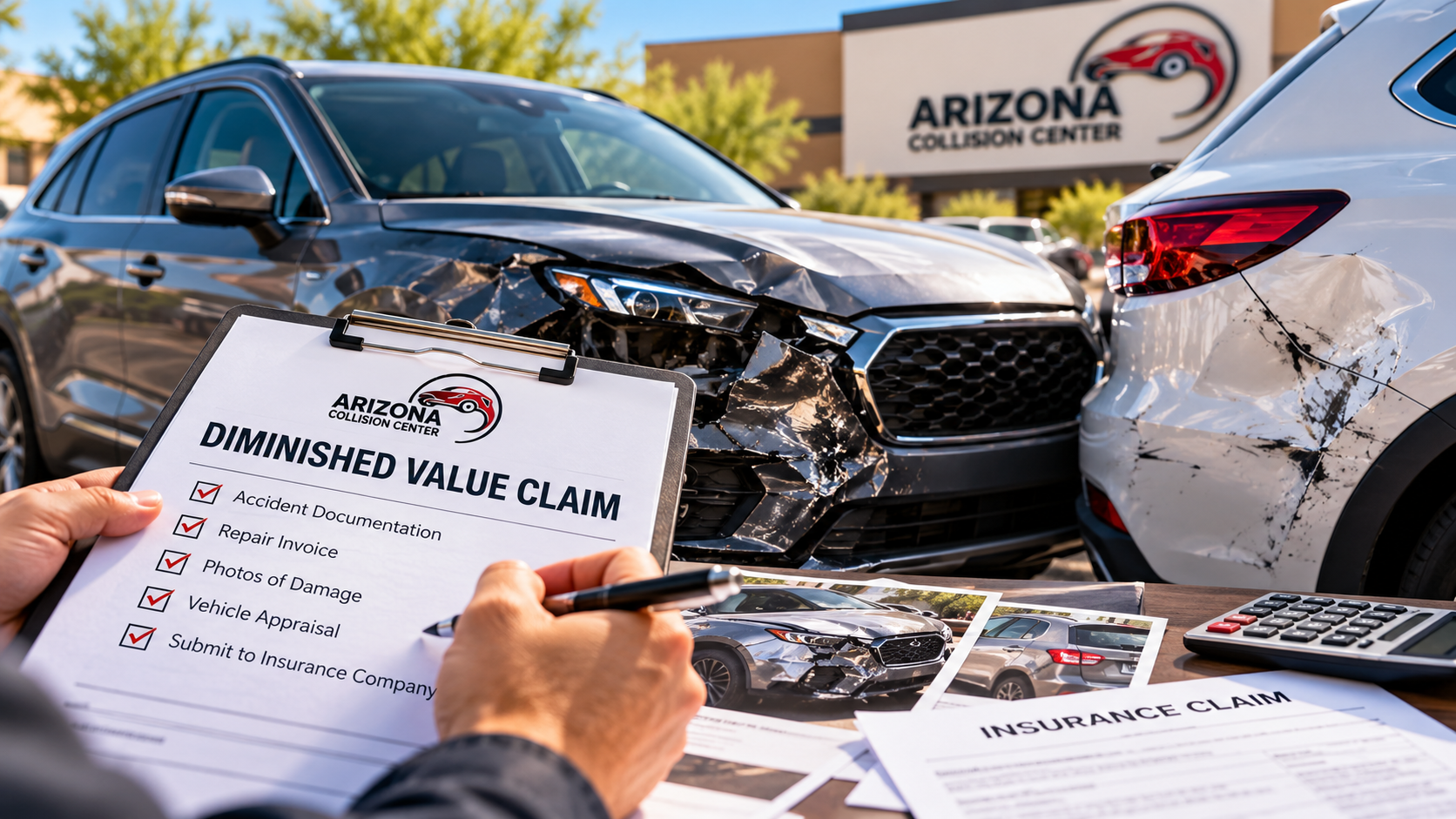
What is Diminished Value and How Do You Claim It in Arizona?
You’ve been in an accident. After your vehicle is repaired at the body shop, it looks as good as new.
You might think your vehicle is worth just as much as it was before the accident.
But that’s not always true.
Even if repairs are done well, an accident stays on your vehicle’s record. Future buyers or dealerships may offer less for your car than they would for a similar one without an accident history.
That loss is known as diminished value.
At Arizona Collision Center in Tempe, we believe Arizona drivers should understand diminished value because repairing the physical damage is only one part of recovering from an accident. If someone else caused the collision, you may also have a legitimate claim for the value your vehicle lost because of that accident.
What Is Diminished Value?
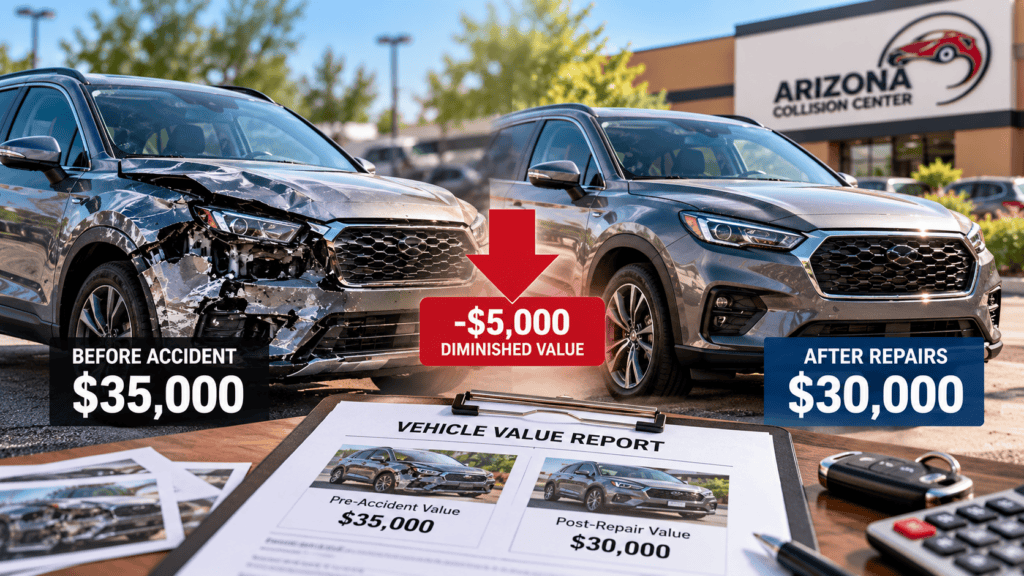
Diminished value is the difference between what your vehicle was worth before an accident and what it is worth after the accident and repairs.
Here’s a simple example.
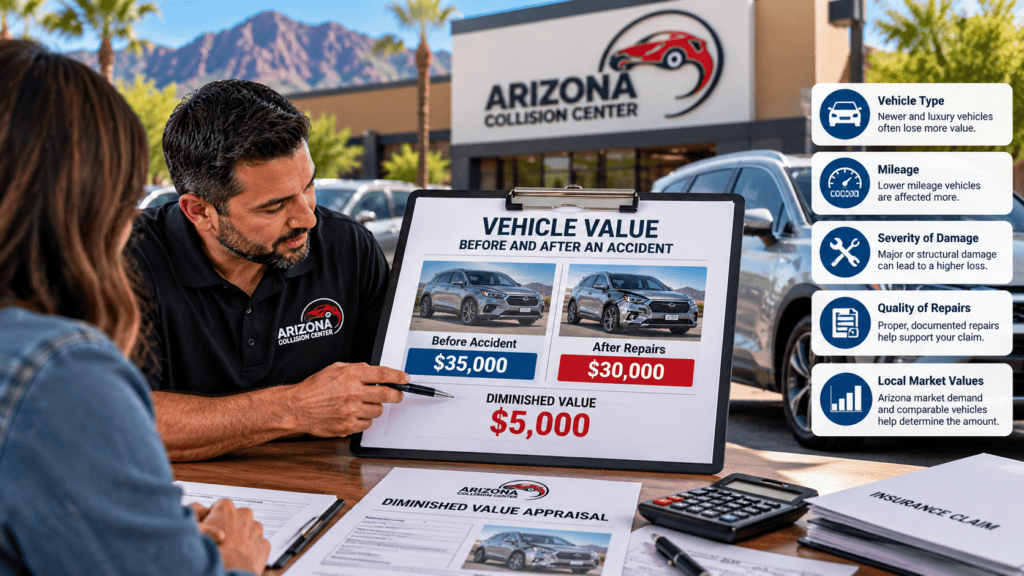
Suppose your vehicle was worth $35,000 immediately before an accident. After professional collision repairs, its accident history causes its reasonable market value to fall to $30,000.
The $5,000 difference is your vehicle’s diminished value.
The important thing to understand is that diminished value is separate from the cost of repairing your vehicle.
Your collision repair claim addresses the physical damage caused by the accident. A diminished value claim addresses the potential loss in the vehicle’s market value that remains after those repairs.
Can a Repaired Car Still Have Diminished Value?
Yes.
A vehicle doesn’t necessarily have to be poorly repaired to experience diminished value.
Even with proper repairs, buyers may see a car with an accident history differently than one that’s never been damaged.
That’s especially relevant with newer vehicles, luxury vehicles, low-mileage vehicles and vehicles that sustained significant collision or structural damage.
We can fix the damage, but we can’t remove the accident from your car’s history.
Can You Make a Diminished Value Claim in Arizona?
Arizona allows claims for diminished value if you can prove your loss.
One of the important Arizona cases addressing the issue is Oliver v. Henry. The Arizona Court of Appeals concluded that a vehicle owner did not have to actually sell or trade the vehicle to demonstrate diminished value.
This matters.
You don’t have to wait years until you trade in your car to find out how much value it lost. You can show diminished value with the right evidence, like a professional appraisal.
For many Arizona drivers, the most straightforward situation involves pursuing a third-party property-damage claim when another driver caused the collision.
The specific rights available to you depend on the facts of the accident, the applicable insurance coverage and other circumstances. If there is a significant amount of money involved or a dispute over liability, speaking with an attorney or qualified diminished-value professional may be appropriate.
How Do You File a Diminished Value Claim in Arizona?
If you’ve been involved in an accident in Tempe, Phoenix, Mesa, Chandler, Gilbert, Scottsdale or elsewhere in Arizona, the process generally starts after the collision damage has been properly documented and repaired.
Here are the basic steps we recommend considering.
1. Make Sure the Collision Repairs Are Properly Completed
Before determining how much value your vehicle lost, you need to know exactly what was damaged and repaired.
Keep your final repair invoice, original estimate, insurance estimates, supplements, photographs and other documentation related to the collision.
At Arizona Collision Center, we document the repair process carefully because those records can become important later.
2. Determine the Vehicle’s Pre-Accident Value
Next, ask yourself:
What was your car worth right before the accident?
Several factors can affect that number, including:
- Year, make and model
- Mileage
- Trim level and options
- Overall condition
- Previous accident history
- Local Arizona vehicle values
- Current market demand
Online pricing guides are helpful, but a detailed appraisal that looks at your specific car and the local market can make your claim stronger.
3. Determine Its Post-Repair Market Value
Now, compare that number to what your car is worth after the accident and repairs.
A qualified independent appraiser can help with this step.
The appraiser will look at your car, review repair records, check how bad the damage was, research similar cars, and see how the accident history affects its value.
At Arizona Collision Center, we can help customers connect with qualified professionals when a diminished value appraisal is appropriate.
4. Document the Difference
Your claim should be supported by evidence rather than simply telling an insurance company, “My car is worth less now.”
Useful documentation can include:
- Professional diminished value appraisal
- Final collision repair invoice
- Insurance estimates and supplements
- Before-and-after photographs
- Vehicle history information
- Comparable vehicle values
- Dealer trade-in information when available
- Documentation of structural or significant collision damage
The better your documentation, the easier it is to prove your loss.
5. Submit the Diminished Value Claim
Once you know the amount, you can send your diminished value claim and supporting documents to the insurance company.
The insurance company may not agree with your number right away.
They might do their own evaluation, question your appraisal, offer less, or ask for more documents.
That doesn’t mean your claim isn’t valid.
It just means you may need to back up your claim with more evidence.
How Much Is a Diminished Value Claim Worth in Arizona?
There isn’t one number or percentage that applies to every vehicle.
Be careful with websites that tell you a diminished value claim is automatically worth a certain percentage of your car’s value.
The actual loss can depend on the vehicle, mileage, age, pre-accident condition, type of damage, severity of the collision, repairs performed and how buyers in the market respond to the vehicle’s accident history.
For example, a newer luxury car with low miles and major damage will be affected differently than an older car with high miles and a minor accident.
That’s why we recommend looking at the actual vehicle rather than relying entirely on an online formula.
Does the Quality of the Collision Repair Affect Diminished Value?
Absolutely.
There’s an important distinction between inherent diminished value and value lost because a vehicle wasn’t repaired correctly.
Even properly repaired vehicles may experience some market-value loss simply because of their accident history.
But improper repairs can potentially make the situation worse.
Problems like mismatched paint, uneven panels, structural issues, warning lights, alignment problems, wrong parts, or safety system issues can all add to the loss.
This is one of the reasons we encourage drivers throughout the Phoenix area to choose their collision repair facility carefully.
At Arizona Collision Center, we don’t just make your car look good from a distance. We follow the manufacturer’s repair procedures to restore your vehicle the right way.y.
Do I Have to Sell My Car to Prove Diminished Value in Arizona?
No.
This is one of the most important things Arizona drivers should know.
Arizona case law has recognized that an owner doesn’t have to sell, trade or otherwise dispose of a repaired vehicle simply to establish that it suffered a provable loss in value.
A qualified appraisal and other evidence can be used to demonstrate the difference between the vehicle’s pre-accident and post-repair value.
That means you can potentially pursue diminished value even if you plan on keeping your vehicle.
Does the Insurance Company Automatically Pay Diminished Value?
No.
A diminished value payment generally isn’t something you should assume will automatically be included with your collision repair settlement.
The person seeking compensation may need to raise the issue and provide evidence supporting the claimed loss.
That’s why we talk to our customers about diminished value.
Most people aren’t collision repair or insurance experts. They may go through one serious accident in their entire lives. We deal with collision claims every day, and part of our job is helping customers understand questions they may not even know they should be asking.
What Vehicles Are Most Likely to Have Significant Diminished Value?
Any car can lose value after an accident, but it’s especially important to check for diminished value if your car is:
- Relatively new
- Low mileage
- High value
- A luxury or performance vehicle
- Previously accident-free
- In excellent pre-accident condition
- Involved in significant structural damage
- Repaired after a major collision
If you’re driving a newer vehicle around Tempe, Scottsdale, Phoenix, Chandler, Gilbert or Mesa and another driver causes substantial collision damage, diminished value is something worth investigating rather than ignoring.
Can Arizona Collision Center Help With a Diminished Value Claim?
Yes.
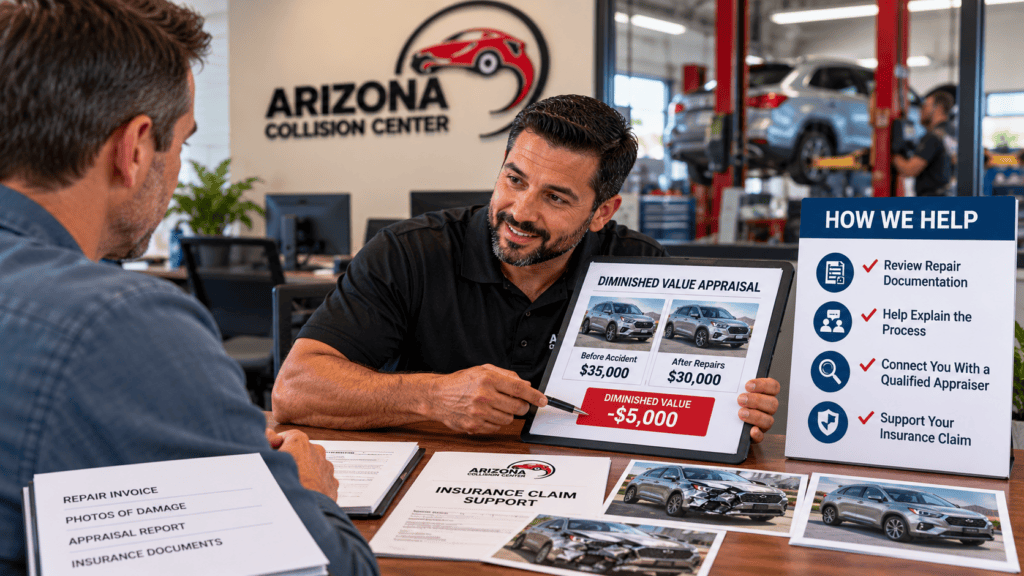
We’re not a law firm and can’t set the legal value of your claim. But we can help you understand your repair documents and connect you with a qualified appraiser if needed.
More importantly, we can make sure the repair side of the process is thoroughly documented.
That can include the original damage, repair procedures, replacement parts, insurance supplements and final repairs.
We’ve helped Arizona drivers with repairs and insurance claims for years. We want our customers to understand both the repairs and the financial issues that can come after a serious accident.
Frequently Asked Questions About Arizona Diminished Value Claims
What does diminished value mean after a car accident?
Diminished value is the reduction in a vehicle’s market value caused by its accident history, even after the collision damage has been repaired.
Can I claim diminished value if the accident wasn’t my fault in Arizona?
Potentially, yes. Third-party diminished value claims may be available when another party caused the accident, but the validity and amount of a particular claim depend on the circumstances and supporting evidence.
Do I need a diminished value appraisal?
An independent professional appraisal can provide important evidence by estimating your vehicle’s market value before the accident and its value after the collision and repairs.
Can I claim diminished value without selling my car?
Yes. Arizona courts have recognized that a vehicle doesn’t have to be sold or traded in before an owner can establish a provable diminished-value loss.
When should I start thinking about diminished value?
Don’t wait years until you trade in your car. Keep your accident and repair records and check for diminished value soon after the repairs are done.
Been in an Accident in the Phoenix Area? Don’t Forget About Your Vehicle’s Value
If another driver damages your vehicle, getting it repaired correctly should be your first priority.
But it shouldn’t necessarily be your last question.
Once the repairs are complete, ask yourself:
What was my vehicle worth before this accident, and what is it worth now?
If those numbers aren’t the same, you may want to investigate a diminished value claim.
At Arizona Collision Center, we help drivers throughout Tempe, Phoenix, Scottsdale, Mesa, Chandler, Gilbert and surrounding Arizona communities navigate the collision repair and insurance process.
Our collision center is located at 215 South Industrial Drive in Tempe, AZ 85288, conveniently near Loop 101 and Rio Salado Parkway.
If you’ve been in an accident and have questions about collision repair, insurance claims or diminished value, call Arizona Collision Center at (480) 668-3105. We’ll help you understand the repair process and what steps you may want to take next.



No Comments
Sorry, the comment form is closed at this time.